Using AI in Your Business: When ISO 42001 Applies
Artificial intelligence is now used across many areas of business operations. Organisations are deploying AI tools to analyse data, automate tasks, improve products, and support decision-making. But as AI becomes more widely adopted, a common question emerges: when does ISO 42001 actually apply?
The answer depends on how AI is used within the organisation and the potential risks associated with those systems.
What ISO 42001 Is Designed to Address
ISO 42001 is a management system standard designed to help organisations govern the lifecycle of artificial intelligence systems. The standard focuses on ensuring that AI systems are:
- properly documented
- assessed for risks
- monitored after deployment
- subject to appropriate oversight
It applies to organisations that develop, deploy, or use AI systems as part of their operations or services.
When ISO 42001 Typically Applies
In practice, ISO 42001 is most relevant when AI systems influence business processes, decisions, or products. Several common scenarios illustrate when organisations should consider implementing an Artificial Intelligence Management System (AIMS).
When AI Is Embedded in Products or Services
Many technology companies now embed AI capabilities into their products. Examples include:
- recommendation engines
- predictive analytics tools
- AI copilots or assistants
- automated decision systems
- AI-powered search or insights
When AI features become part of a product offering, organisations must ensure these systems are reliable, transparent, and appropriately governed. ISO 42001 helps establish governance processes for these AI-enabled products.
Many SaaS companies are rapidly adding AI features without clear governance structures. Organisations often only start thinking about AI governance when enterprise customers begin asking questions about how AI systems are managed — at which point having a framework already in place becomes a significant competitive advantage.
When AI Influences Important Decisions
Some AI systems influence decisions that may affect customers, employees, or financial outcomes. Examples include AI used for:
- fraud detection
- credit or risk scoring
- recruitment screening
- customer segmentation
- operational forecasting
In these situations, organisations need processes to ensure AI systems are fair, reliable, and monitored for unintended outcomes. ISO 42001 provides a framework for implementing these processes.
When AI Is Used Across Internal Operations
AI is increasingly used internally to support business operations. Examples include:
- AI-powered analytics tools
- automated document analysis
- productivity copilots
- AI-supported coding tools
- marketing optimisation systems
Even when AI is not customer-facing, organisations may still need governance processes to manage risks such as incorrect outputs, misuse of AI-generated information, data handling concerns, and overreliance on automated decisions.
When Organisations Use Third-Party AI Tools
Many companies assume ISO 42001 only applies to organisations that develop their own AI models. In reality, organisations that use third-party AI tools may still need governance processes. Examples include:
- large language models integrated into workflows
- AI-powered SaaS platforms
- automated analytics systems
- AI-assisted decision tools
Even when the underlying technology is provided by a vendor, organisations remain responsible for how AI systems are used and the outcomes they produce.
Many organisations are discovering that AI adoption is happening informally across teams — employees using generative AI tools without formal governance policies. This creates hidden risks around data handling, output reliability, and accountability that a structured AIMS is designed to address.
When Regulatory Expectations Apply
For organisations operating in the United Kingdom and European Union, regulatory developments are also influencing when AI governance becomes necessary. The EU AI Act introduces requirements for certain categories of AI systems, particularly those considered high-risk. Examples of high-risk AI systems may include technologies used for:
- recruitment and employment decisions
- credit risk assessment
- biometric identification
- educational assessment systems
These systems may require formal risk management, documentation, and oversight processes. Although ISO 42001 is not a legal requirement, the governance framework it provides can help organisations implement many of the processes expected by regulators.
European organisations are increasingly viewing ISO 42001 as a practical way to prepare for EU AI Act governance requirements. Implementing a structured AIMS now puts organisations ahead of regulatory expectations, rather than in a position of having to react to them.
Situations Where ISO 42001 May Not Be Necessary
Not every organisation currently needs to implement a full AI management system. Organisations that do not use AI technologies, use AI only in limited low-risk ways, or rely on simple automation rather than AI models may not require the full governance framework defined by ISO 42001.
However, as AI capabilities become more widely embedded in software and digital platforms, this situation is becoming less common.
Key Questions to Ask When Evaluating ISO 42001
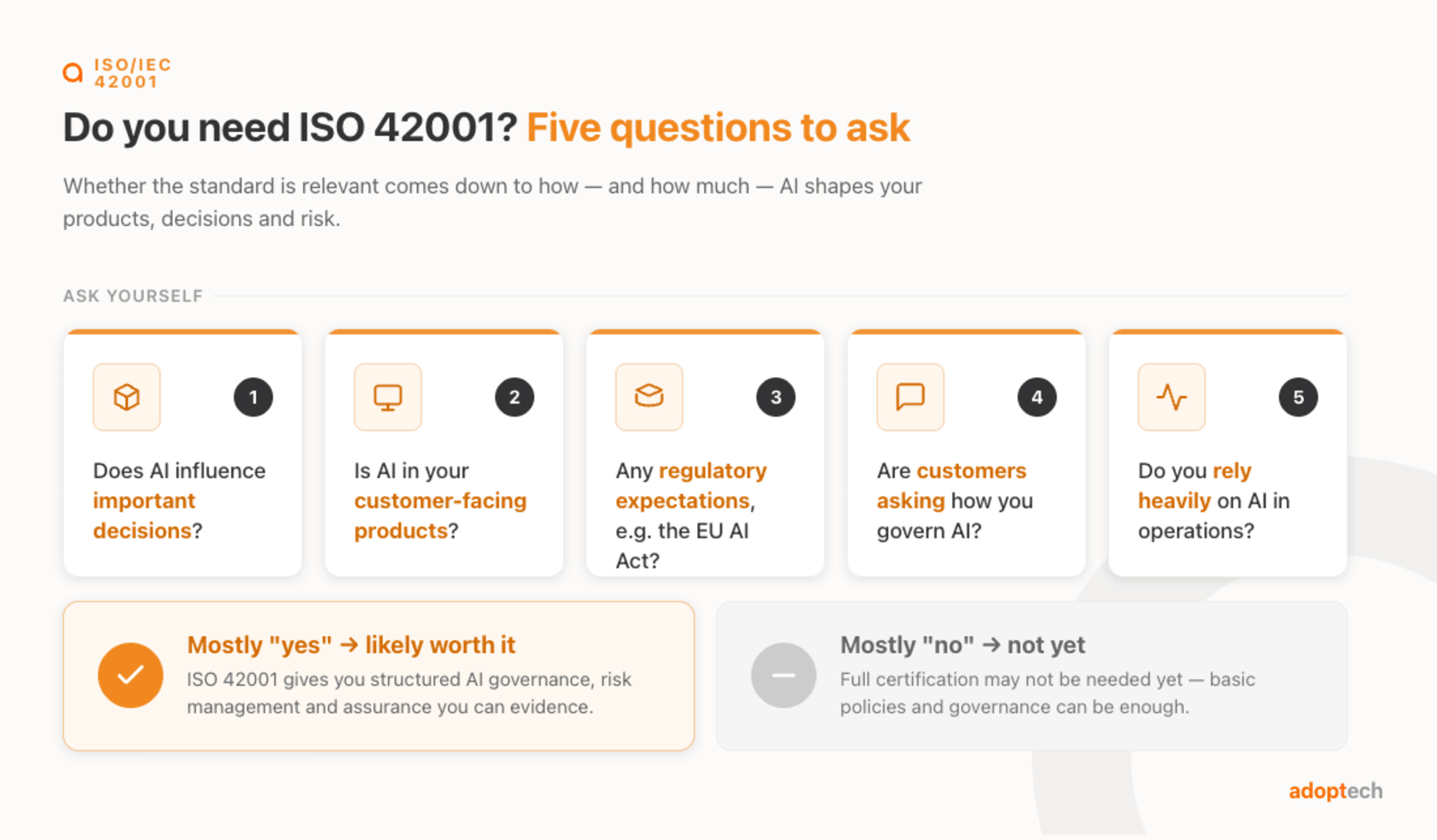
Organisations assessing whether ISO 42001 applies to them should consider the following.
If AI systems influence outcomes that affect individuals or organisations, governance becomes more important.
AI-powered product features often require oversight, monitoring, and documentation.
Enterprise customers and regulators increasingly expect organisations to demonstrate responsible AI practices.
Companies operating in Europe may need to consider how AI governance aligns with the EU AI Act and other regulatory expectations.
Why More Organisations Are Implementing AI Governance
AI adoption is accelerating across industries, and organisations are increasingly recognising that governance is necessary to ensure AI systems operate responsibly. ISO 42001 provides a structured framework for implementing governance processes that help organisations:
- manage AI risks
- maintain oversight of AI systems
- demonstrate responsible AI practices
- prepare for regulatory developments
For organisations deploying AI technologies at scale, these governance processes are becoming an essential part of modern technology risk management.
Key Takeaways
ISO 42001 applies to organisations that develop, deploy, or rely on artificial intelligence systems within their operations or products. The standard becomes particularly relevant when:
- AI is embedded in products or services
- AI systems influence important decisions
- organisations use third-party AI tools
- regulatory expectations around AI governance apply
For organisations operating in the UK and European Union, ISO 42001 can also provide a structured framework for preparing governance processes aligned with the EU AI Act and evolving regulatory expectations.
Frequently Asked Questions
Yes. Organisations that use third-party AI tools may still need governance processes to manage risks associated with those systems.
SaaS companies that embed AI features into their products may benefit from implementing ISO 42001 to manage risks and demonstrate responsible AI governance.
No. ISO 42001 is a voluntary standard, but the governance processes it requires may help organisations prepare for regulatory expectations introduced by the EU AI Act.
Organisations should start considering AI governance when AI systems influence business decisions, products, or services.
Not sure if ISO 42001 applies to you?
Our UK-based compliance specialists can help you assess your AI governance needs and build a framework that fits your organisation — without unnecessary complexity.
Talk to our team