Who Needs ISO 42001 (and Who Probably Doesn't)
Artificial intelligence is now embedded in many business tools and digital products. Organisations are increasingly using AI for automation, analytics, customer interaction, and decision support. As AI adoption grows, many companies are asking a practical question: do we actually need ISO 42001?
The answer depends largely on how your organisation develops, deploys, or uses artificial intelligence systems. This article explains which organisations are most likely to benefit from ISO 42001 and which may not need it — at least not yet.
Quick Answer: Who Typically Needs ISO 42001?
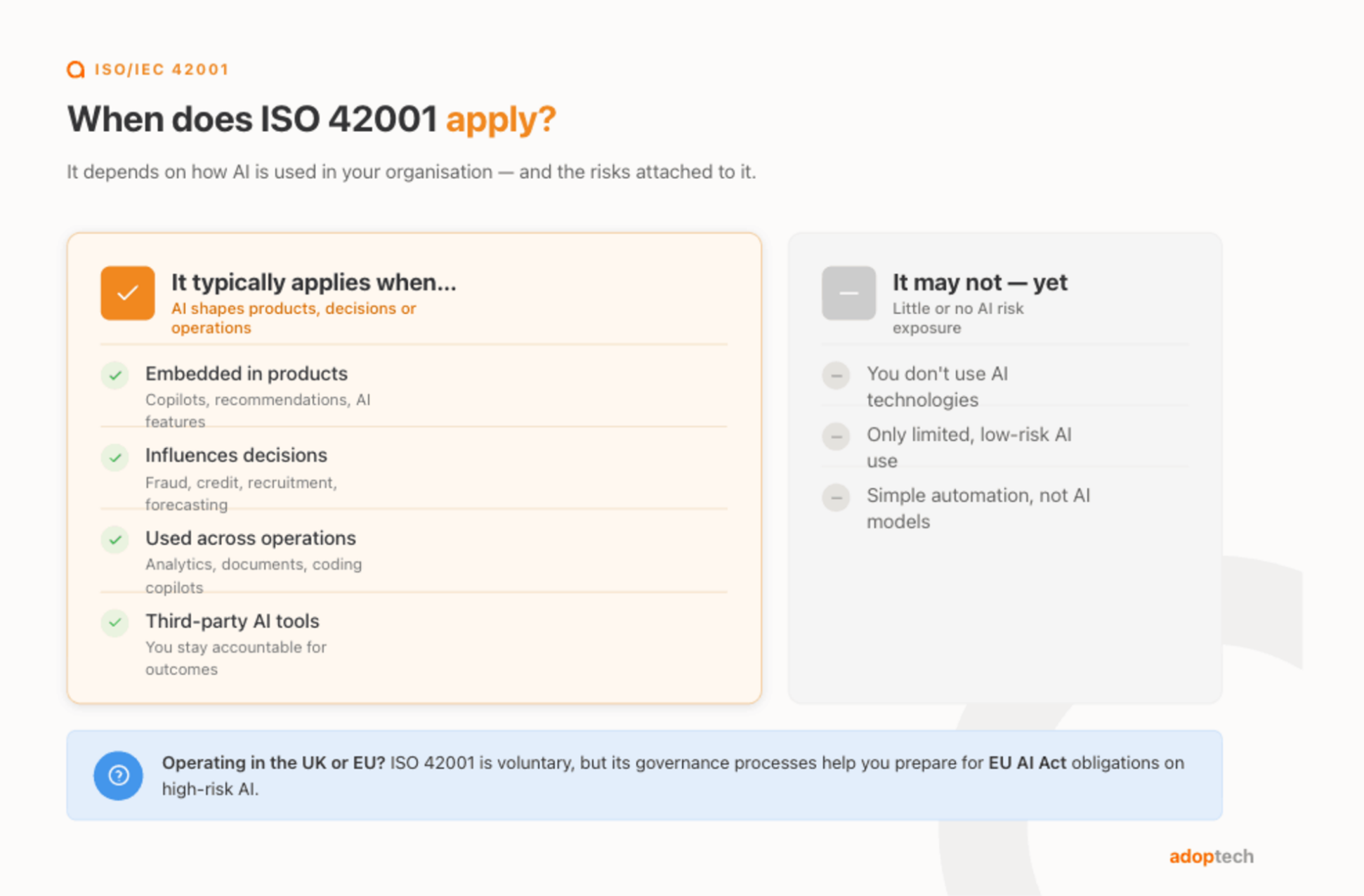
Organisations are most likely to benefit from ISO 42001 if they:
- Build AI features into products or services
- Use AI systems to make or support decisions
- Deploy AI tools across business operations
- Provide AI-enabled technology platforms
- Operate in regulated industries
- Do not use AI in products or processes
- Only use AI in very low-risk ways
- Use basic productivity tools only
- Use AI for non-critical internal automation
Companies in these situations often need clear governance and risk management for AI systems, which is exactly what ISO 42001 provides.
Organisations That Commonly Implement ISO 42001
- Recommendation engines
- Predictive analytics
- AI copilots
- Automated decision systems
- Large language model integrations
- Credit risk assessment
- Fraud detection
- Investment modelling
- Transaction monitoring
- Hiring or recruitment screening
- Pricing or risk analysis
- Customer segmentation
- Operational forecasting
- AI platforms and APIs
- Enterprise AI tooling
- AI-enabled SaaS platforms
- Responsible AI assurance
Organisations That May Not Need ISO 42001 (Yet)
Not every organisation currently needs a formal AI management system.
Businesses That Do Not Use AI
Organisations that do not use artificial intelligence in their products, services, or internal processes may not need ISO 42001. However, this situation is becoming less common as AI tools become widely embedded in business software.
Companies Using AI in Very Limited Ways
Some organisations only use AI in low-risk ways, such as basic productivity tools, internal document summarisation, or non-critical automation. In these cases, organisations may still need basic governance and policies, but full ISO 42001 certification may not yet be necessary.
What About Organisations Using Third-Party AI Tools?
A common misconception is that ISO 42001 only applies to companies that build AI systems themselves.
In reality, organisations that use third-party AI tools may still need governance processes. Examples include using:
- AI copilots in software development
- AI analytics tools
- AI-powered customer service platforms
- large language models integrated into workflows
Even when AI is provided by a supplier, organisations remain responsible for how those systems are used and the outcomes they produce.
Key Factors That Determine Whether ISO 42001 Is Relevant
Organisations evaluating ISO 42001 should consider several questions.
If AI systems influence decisions affecting customers, employees, or operations, governance becomes more important.
AI features in products or platforms often require clear accountability and oversight.
Many regulators are introducing requirements related to algorithmic fairness, transparency of automated decisions, and risk management for AI systems. In Europe, organisations must increasingly consider the EU AI Act, which introduces regulatory obligations for certain AI systems, particularly those classified as high-risk. Implementing ISO 42001 can help organisations establish many of these governance processes in a structured and auditable way.
Enterprise buyers increasingly ask suppliers: How is AI monitored? How do you manage AI bias risks? Who is accountable for AI systems? Implementing ISO 42001 can help organisations provide clear answers to these questions.
Why More Organisations Are Considering ISO 42001
AI adoption is accelerating across industries, and organisations are under increasing pressure to demonstrate responsible use of AI technologies. ISO 42001 provides a recognised framework for:
- AI governance
- risk management
- oversight of automated systems
- continuous monitoring and improvement
For organisations that rely heavily on AI, implementing a structured management system can help build trust with customers, regulators, and partners.
Key Takeaways
ISO 42001 is most relevant for organisations that develop, deploy, or rely heavily on artificial intelligence systems. Companies most likely to benefit include:
- SaaS providers building AI features
- financial services firms using AI models
- technology providers offering AI platforms
- organisations using AI to support decision-making
Businesses that do not use AI, or only use it in limited low-risk ways, may not yet need full ISO 42001 certification. However, as AI becomes more embedded in products and operations, more organisations are likely to require structured AI governance frameworks.
Frequently Asked Questions
SaaS companies that build or integrate AI features may benefit from ISO 42001 to manage risks and demonstrate responsible AI governance.
Yes. Organisations remain responsible for how AI tools are used and the outcomes they produce.
ISO 42001 is not currently mandatory in most jurisdictions, but it can help organisations demonstrate responsible AI governance and prepare for emerging regulation.
Yes. ISO management systems are scalable and can be implemented by organisations of different sizes, provided the framework is proportionate to their use of AI.
ISO 42001 is not a legal requirement under the EU AI Act, but it provides a structured framework for AI governance and risk management. Organisations implementing ISO 42001 may find that many of the processes required by the standard support preparation for EU AI Act obligations.
Not sure if ISO 42001 is right for you?
Talk to our UK-based compliance specialists. We'll help you assess your AI governance needs and find the right approach for your organisation.
Talk to our team